One project · days 0 to 90
English & Español
Stand up a job's safety program in 90 days, starting from a bare trailer.
Site Stand-Up is one project's whole safety program set, with a playbook that lays out the first 90 days step by step: what gets done, which document it goes on, who owns it, and what proves it was done. Three signed gates show what was in place, and when.
Priced for one project, not for a whole company. If you run a company and want the same programs across every job, the SP-CPM Program Add-on is the better fit.
- Documents, English and Spanish308
- Programs, permits, logs and forms166
- Craft toolbox talks, 14 trades140
- People from the job, besides youup to 4
- Signed gates in the first 90 days3
Job runs past twelve months? Ask us about renewing for $195.
What it is
Most new jobs start the same way. Somebody gets handed a trailer, a contract and a start date, and is told to have a safety program running before the first crew shows up. The programs get borrowed from the last job, the forms come from three different places, and nobody can say for sure what is actually in place on day 30.
Site Stand-Up replaces that scramble with one set and one schedule.
The program set
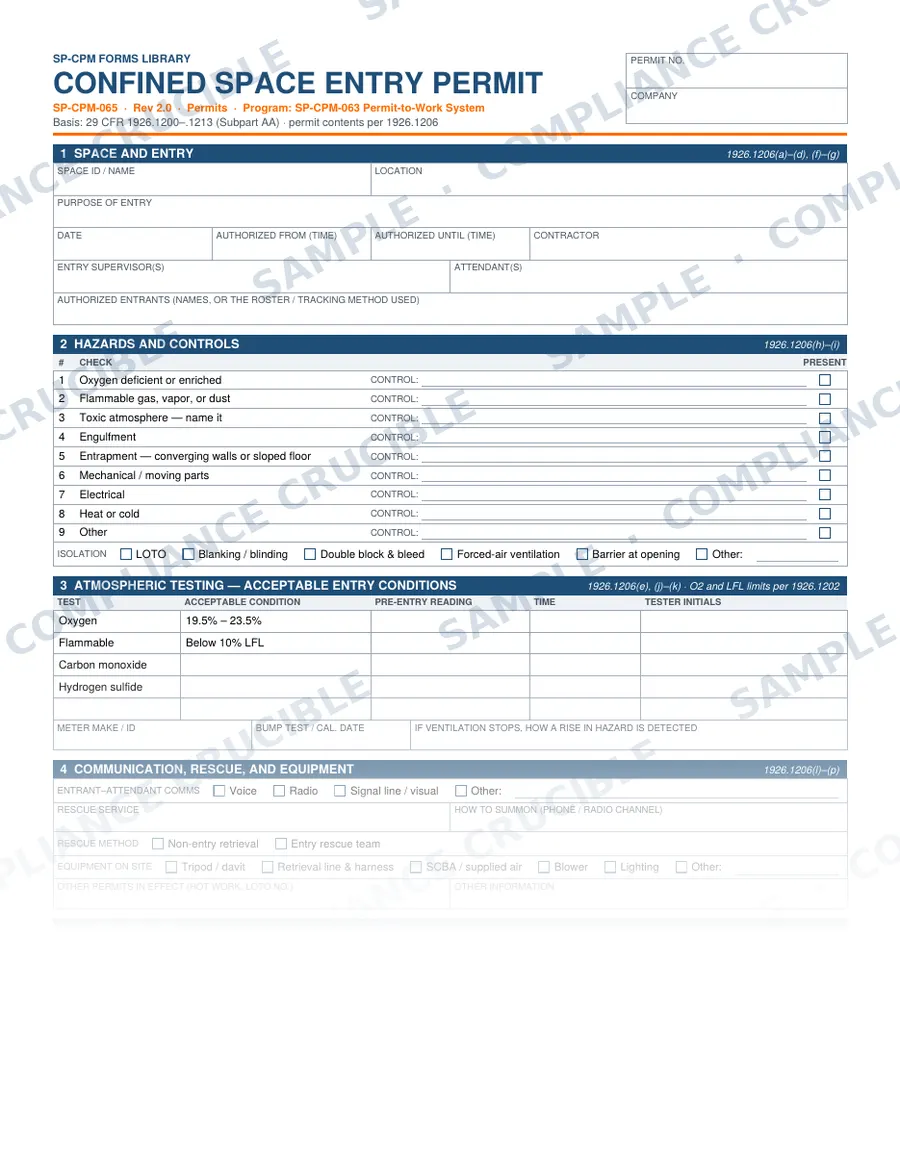
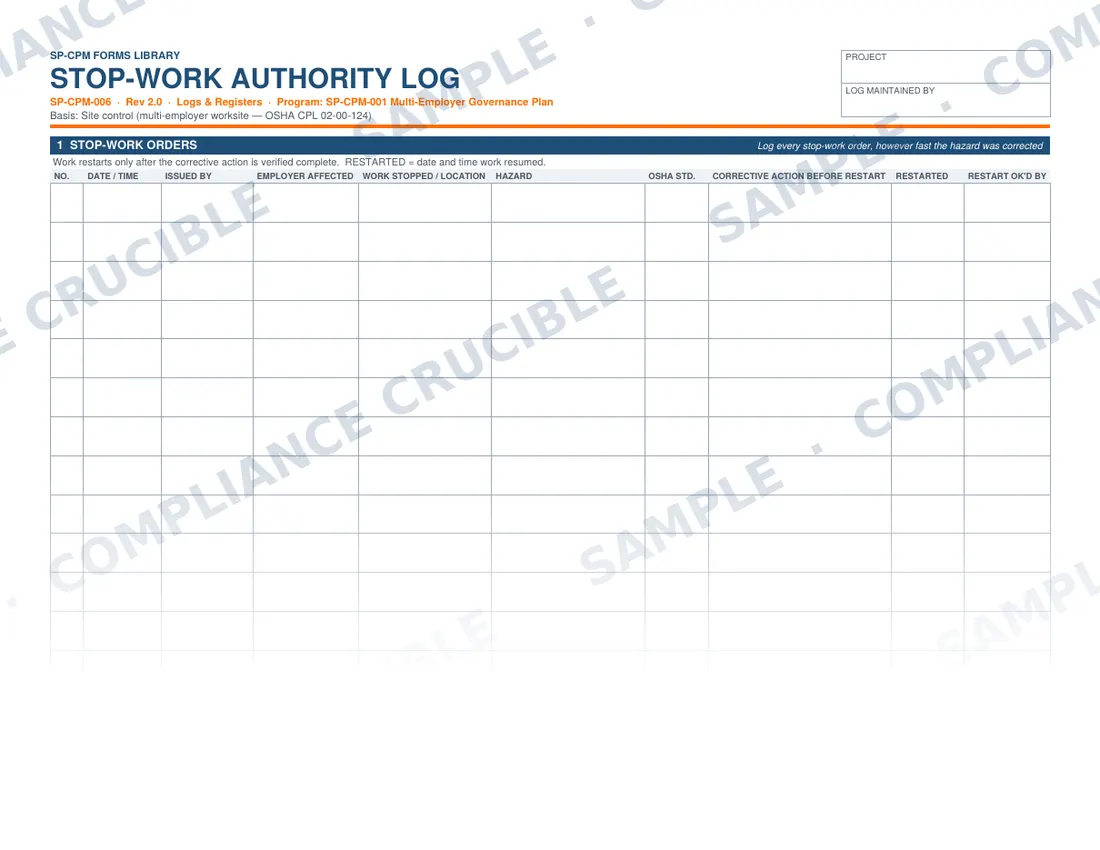
Written safety programs and every permit, log, checklist and form they call for: governance, subcontractor control, orientation, JHA and AHA, inspections, corrective actions, incidents, emergency plans, fall protection, excavation, cranes, confined space, electrical, silica, respiratory, hot work and the rest.
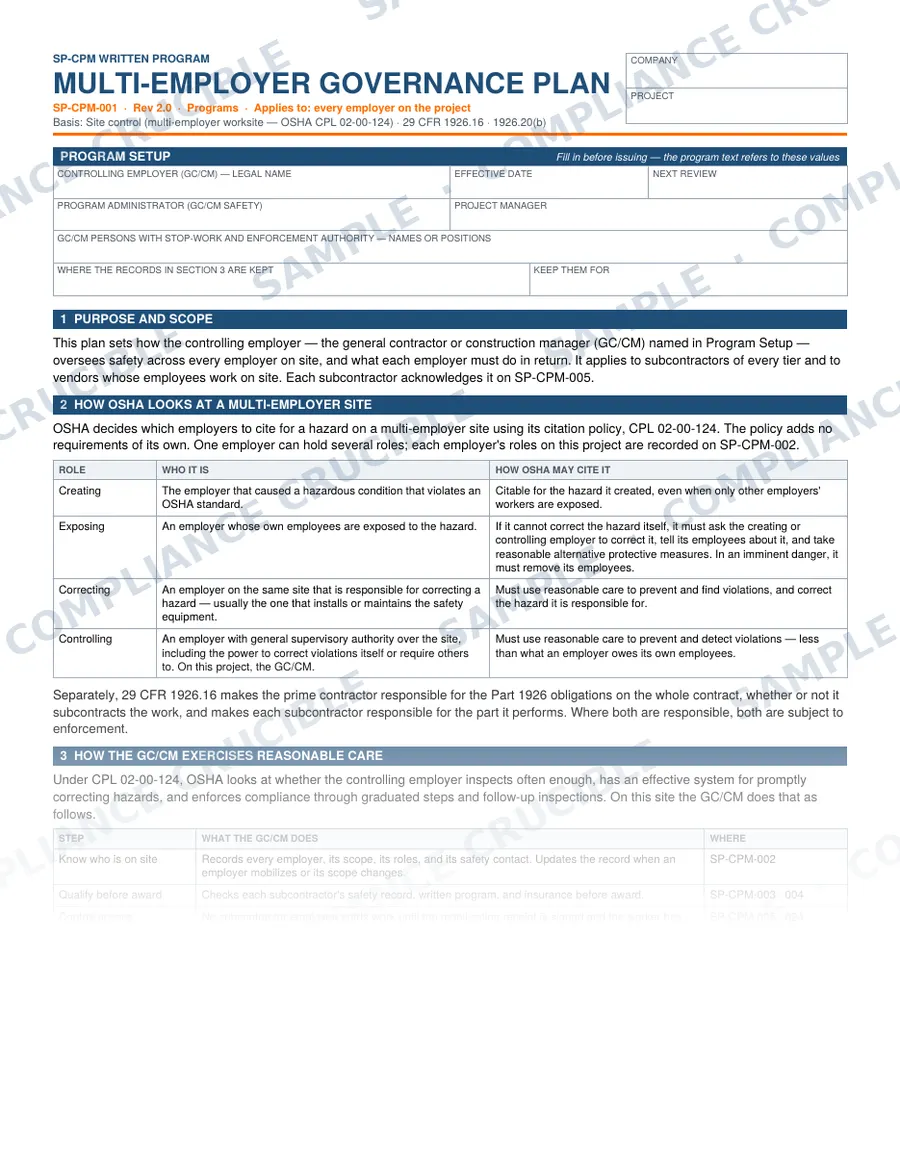
Each program has a Program Setup page where the job's own choices get written in, so the program reads like this project and not like a template.
The playbook
The working checklist for days 0 to 90. Every line names what gets done, the document, the owner and the proof. Tick the step when the proof exists.
A gate sits in front of each phase. The safety lead and the project manager both sign it, so the job does not move on with holes behind it.
The crew side
Toolbox talks for 14 crafts, ten talks each, in English and Spanish. Enough to set a talk schedule for every subcontractor on the job in the first month and keep it going.
Plus a how-to booklet for issuing a program, and a number key that tells you what every document number means.
How the 90 days run
Four stretches. The first two are about getting control of the site. The third adds programs only when the work calls for them. The fourth proves that what was set up is actually running.
Before mobilization
Eight steps that settle who has authority and what this job needs.
- Engagement and authority letter signed
- Private track, or federal with EM 385-1-1
- State and city addendum checked
- Owner and insurer requirements read out of the contract
- Program list, with an owner beside each
Establish control
What has to be in place before production work starts, then the first month's routines.
- Governance plan and employer role matrix
- Subcontractor procedure started
- Orientation, emergency plan, SDS access, 300 Log
- Permits, inspections, corrective action log
Expand
Programs start when their trigger happens, not on a date. No trigger on this job, write N/A.
- Fall protection, excavation, cranes, confined space
- Silica, respiratory, lead, scaffolds, steel, heat, hearing
- Weekly inspections and sub self-inspections running
- First trend report to project leadership
Mature
No new programs for their own sake. Show that hazards are found, corrected, checked and reviewed.
- Management audit and management review
- Emergency drill held and reviewed
- 300 Log checked against the incident records
- 90-day status report delivered
What a line in the playbook looks like
These are real lines from the playbook. Every step reads the same way, so nobody has to guess what "done" means.
| What gets done | Document | Owner | Proof it is done |
|---|---|---|---|
| Post the competent person roster. | SP-CPM-008 | Safety lead | Roster posted and current |
| Start orientation and hold the first class. | SP-CPM-024, 025, 026 | Safety lead | Orientation record and sign-in for everyone on site |
| Permit system issued and walked through with supervisors. | SP-CPM-063, 056, 064 to 066, 068, 069 | Safety lead | Permit forms in supervisors' hands; register opened |
| Every new subcontractor goes through the procedure before mobilizing. | SP-CPM-003, 004, 005 | Safety lead | Checklist and receipt on file for each |
| Corrective actions tracked to closure. | SP-CPM-035 | Safety lead | Log reviewed weekly; open items have owners and dates |
| Emergency drill held and reviewed. | SP-CPM-074, 078 | Safety lead, Superintendent | Drill log and muster report completed |
And a gate. Gate 1 is signed before day 31 only when all seven of these are true: governance documents are signed, not drafts; orientation records exist for everyone on site; the emergency map is posted and the contact directory is current; safety data sheets are reachable; the 300 Log is started; competent persons are named for the hazards on site; permit forms are in supervisors' hands.
Seven jobs it fits
Same set, same playbook. What changes is who is holding it and what they need it to show.
Hired Friday, on site Monday
You are brought in to run safety on a job that mobilizes next week. The contractor has a corporate manual and nothing written for this site.
You name the project, sign the engagement letter with the contractor's officer so your authority is on paper, and start at step 1. By day 15 the programs are adopted, orientation is running and the emergency plan is on the wall. You hand the client a signed Gate 1 instead of a status email.
Leans on: Engagement and Authority Letter (SP-CPM-080), Gate Report (SP-CPM-081)
"Show me the program is real"
You don't run the contractor's safety program, and you still need to know it exists before your name is on the gate sign. A binder on a shelf doesn't tell you that.
Put Site Stand-Up in the contractor's hands, or ask for it by name, and ask for the three gates. Each one is a short list of conditions with the record that shows each, signed by the safety lead and the project manager. You see what was in place on day 30, day 60 and day 90.
Leans on: Gate Report (SP-CPM-081), 90-Day Status Report (SP-CPM-082)
A solar site and eleven subcontractors
Civil, piles, racking, modules, electrical, fence and seeding, most of them arriving within six weeks of each other, each with their own paperwork or none.
The subcontractor procedure starts in the first two weeks: prequalification, a mobilization package each sub signs for, and self-inspections that come back to you. The employer role matrix says in writing who controls what. The competent person roster is re-posted as each sub arrives.
Leans on: SP-CPM-002, 003, 004, 005, 008, 034
The same answer on every job
You manage several projects for different owners, and each one's safety startup looks different depending on who the super is.
One Site Stand-Up for each project gives every job the same first 90 days and the same three gates. When the owner asks where a project stands, the answer is a gate number and a date.
Leans on: the playbook (SP-CPM-079), one copy per project
The insurer wants a records package
Sixty days in, the carrier's loss control rep asks for evidence of the safety program: orientation, inspections, corrective actions, training.
The readiness index is the cover sheet for that package. It lists seventeen kinds of record, from the signed governance plan to the training matrix, with a box for included or not asked for and the tab or file where each one sits. Because the playbook asked for proof at every step, the records already exist. You assemble the package; you don't go hunting for it.
Leans on: Owner and Insurer Readiness Index (SP-CPM-083)
An EM 385-1-1 job
The contract calls for an accident prevention plan, activity hazard analyses and a named site safety and health officer.
Choose the federal track before mobilization. The playbook adds the federal steps where they belong: the officer designated, the plan drafted and submitted, and an accepted activity hazard analysis for each phase of work before Gate 2.
Leans on: SP-CPM-015, 016, 019, 020
The safety lead changes in month four
The person who set it all up moves to the next project. The new one inherits a trailer full of binders and no map.
The handover record says what is running, what is open and where the records are. The three signed gates stay with the project file and show what was in place and when, whoever is asking later.
Leans on: Handover Record (SP-CPM-084)
What the documents look like
Fillable PDFs, English and Spanish, with a blank box for the company name. Nothing of ours is printed on the page except the license line in the footer.
How it works once you buy it
Running a company, not one job?
SP-CPM Program Add-on
The same SP-CPM programs, forms and craft talks, licensed to your company for every job you run, on top of a Field Library subscription.
Library + Programs or All-in
If you are on either plan you have the SP-CPM set and the playbook now. You do not need Site Stand-Up or the add-on.
Not sure which
One project, one client, a start date: Site Stand-Up. Your own company's work, job after job: a company plan. Still not sure, ask and tell us about the job.
The plain-words fine print
What this is, and what it isn't
These are documents for setting up a site's safety program and recording that it was done. The playbook tells you what to put in place and what record shows it. It doesn't make the safety calls. Those belong to the contractor and the competent people on the site.
Nothing here replaces a competent person, a qualified person or a licensed engineer, or the training a standard requires. A signed gate shows that records exist; it does not say the job complies with any rule. Fit every program to the contract, the state and the work in front of you.
Ninety days is the playbook's schedule, not a promise about your job. A program whose trigger never happens is marked N/A, and a job that moves slower takes longer.
Day 0 is easier when the list is already written.
One project, 308 documents in two languages, and a playbook that says what to do first. $495, one time.